
 20 April 2026
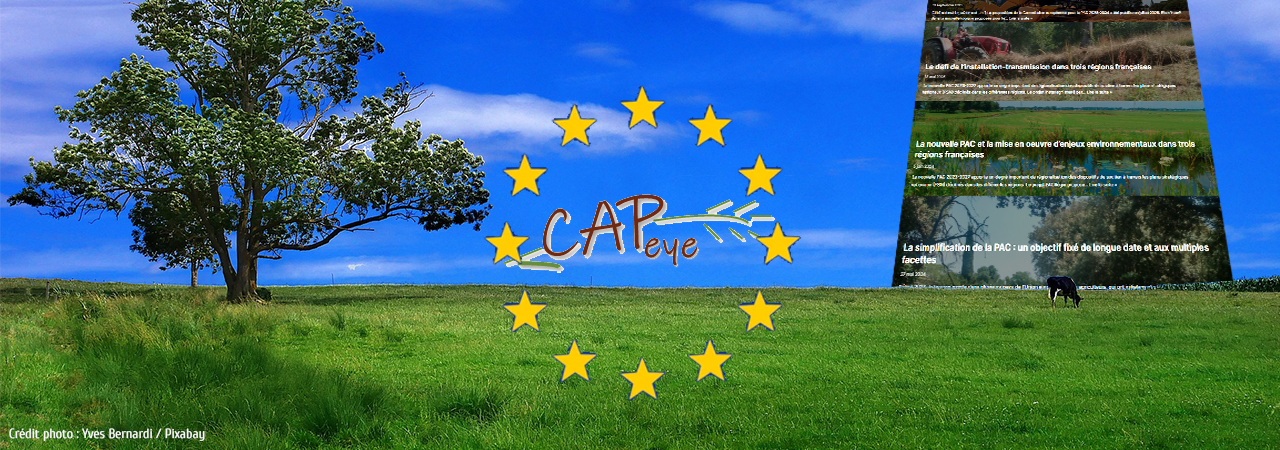
Created in 2014 by two members of the CEE-M, Sophie Thoyer and Pauline Lécole, the CAPeye website brings together a wide range of resources to explore, analyze, and deepen one’s understanding of the Common Agricultural Policy (CAP). We met with the two coordinators of this monitoring and training initiative dedicated to the CAP..

- What led you to create the CAPeye platform? What needs were you aiming to address?
What led you to create the CAPeye platform? What needs were you aiming to address?
The original idea, when we launched CAPeye, was to design a tool that could serve two main purposes. The first was to provide information on a regular basis, but not in the same way as the press or mainstream media. We wanted to deliver content that is more thoroughly analyzed and better explained, aimed at a specific audience.
The second objective was to collect and offer training resources on the Common Agricultural Policy (CAP). We wanted to provide courses accessible to everyone: those who are not very familiar with the CAP but wish to understand how it works, how it is funded and decided, as well as those who already have some knowledge and are looking for more in-depth, specialized insights. We therefore organized the content into two main categories: “CAP for Beginners” and “CAP for Experts.”
- You mentioned a specific audience — who exactly are you targeting?
First of all, it is important to clarify that we are not addressing farmers who want to learn how to complete their CAP declarations or estimate the subsidies they are entitled to. Our goal is not to replace agricultural advisory services, but rather to clearly explain how the CAP was built, its objectives, and how it has evolved over time.
We primarily target an informed audience that seeks to better understand the logic behind CAP interventions. This includes researchers, academic staff, and secondary or technical education teachers. For instance, an agronomist working on crop rotation may need to understand how public policy incentives related to crop diversification function.
Our second target audience consists of master’s students, engineering students in agronomy, spatial planning, or natural resource management. This audience is often in a learning phase and can benefit from CAPeye as a way to gain a broad and structured overview of the CAP.
Finally, our website is also widely used by media professionals and journalists. When agricultural issues make the headlines, they need to understand the CAP—its regulations and mechanisms—since it frames agricultural activity in France and across Europe. For non-specialists, this is highly complex. We are therefore frequently contacted by journalists seeking clarification, as the CAP is a particularly intricate topic.
- CAPeye also offers online training. Could you tell us more about the content you provide?
For all these audiences, we felt it was important to offer targeted training on the CAP, whether for self-learning or for deepening specific topics.
On CAPeye, we provide two types of training. The first is called “CAP for Beginners,” which is freely accessible. Users can find short video clips, concise PowerPoint presentations, and thematic dossiers covering major CAP periods or specific topics such as “peri-urban agriculture and the CAP” or “mountain agriculture.” All of this content is designed to help users understand why agricultural policies are needed, why the CAP exists, how it functioned in the 1960s, how it works today, and so on. To help users assess what they have learned, we also provide a series of quizzes.
We also offer more advanced content in the form of structured courses. These are available upon free registration and are distributed under a Creative Commons license, making them freely accessible. Several modules are specifically dedicated to the CAP, such as its purpose, its history, and so on. We also provide an additional module on public policy evaluation.
In total, we offer around ten online courses that can be followed independently of one another. It is not a MOOC, as there is no predefined progression between the available courses.
There is also the “News” section, which could even be described as “News Analysis.” How do you choose your topics and sources?
Our objective is not to simply reproduce information that can be found elsewhere. We aim to provide thoughtful content that takes a step back, drawing on our expertise to place current events within a broader historical and contextual perspective, and to explain the underlying reasons and mechanisms behind them.
As for topic selection, it varies. Sometimes we jointly decide to address a topic from an original angle. At other times, we build on the research we conduct with our PhD students or interns. For example, we wrote an article on the history of CAP simplification—a topic that is currently in the spotlight due to farmers’ protests, but which has in fact been part of the CAP reform agenda for over 30 years and is the subject of ongoing doctoral research.
Regarding sources, we subscribe to Contexte Agro, which allows us to closely follow developments in agriculture and agricultural policy. It is a very comprehensive but paid source. We also monitor general media outlets such as France Info, Libération, and Le Monde, as well as professional press and more specialized journals where valuable insights can sometimes be found. However, we try as much as possible to go directly to primary sources. We therefore also follow platforms such as Euractiv, and more specifically for CAP-related issues, CAP Reform, a blog run by an Irish colleague.
Keeping up with the news also requires time, as developments move very quickly. We have therefore moved away from a twice-monthly publication schedule. Today, we publish less frequently, which suits us better, as we prioritize quality over quantity.
Today, our newsletter has more than 400 subscribers, and CAPeye offers a comprehensive resource with over sixty news analyses that can be searched by keywords. All articles are archived on the platform, as we believe it is important to preserve these analyses, which contribute to documenting the evolving history of the CAP.